
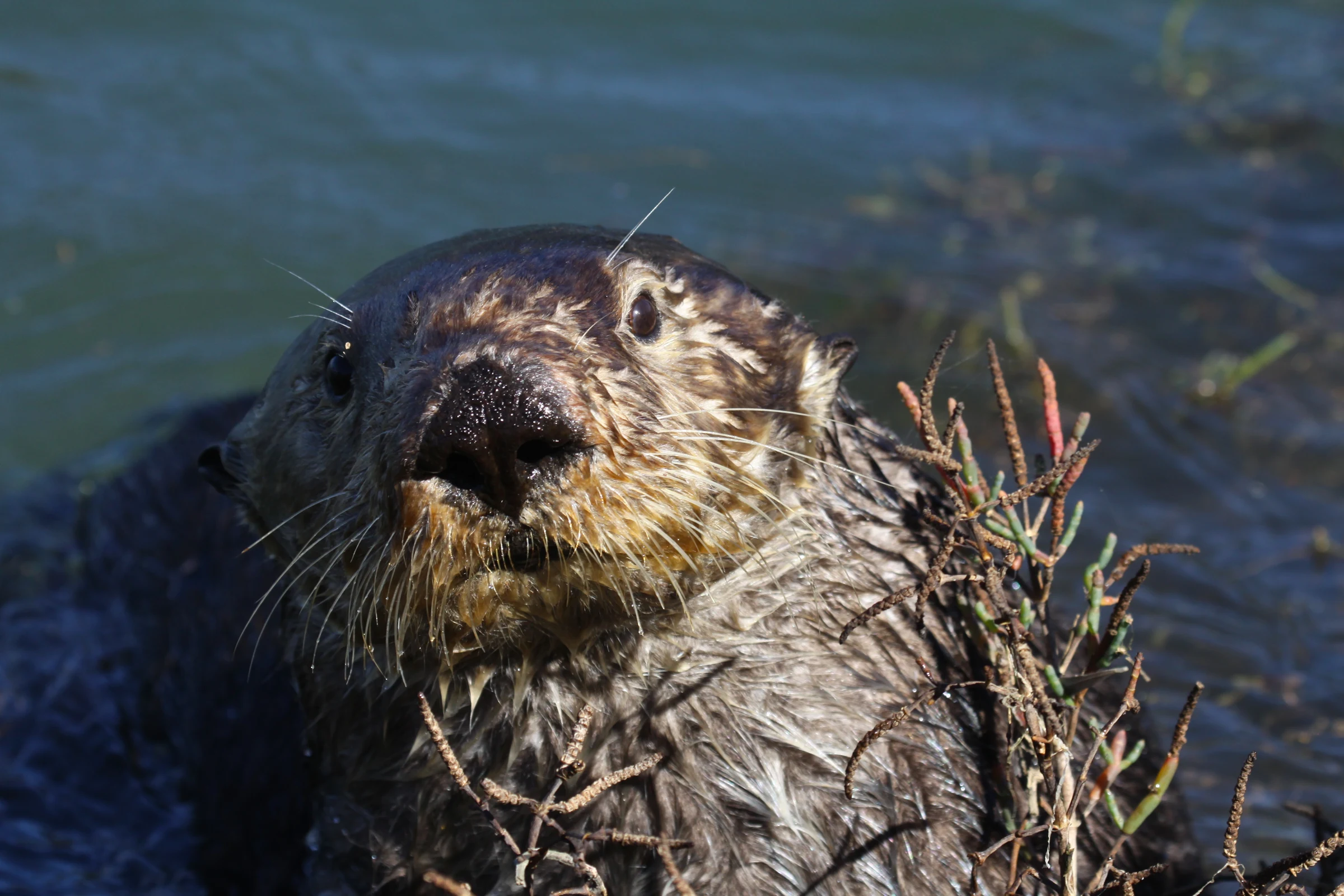
A male southern sea otter foraging for shorecrabs among pickleweed at Moss Landing, California. Illustrative photograph, not an identified study animal or a WOL project. Photo: Lilian Carswell/USFWS.
A sea otter floating on its back looks almost perfectly at ease. Yet staying warm in cold coastal water takes constant work. Unlike seals, sea otters have no insulating layer of blubber. They depend on dense fur and a fast metabolism. Eating and resting are essential parts of the same demanding routine. What an otter eats can also change the habitat around it.
An appetite that changes a shoreline
In California’s Elkhorn Slough, that connection reaches all the way to the edge of a salt marsh. A study published in Nature on January 31, 2024, combined long-term observations with experiments to investigate what happened as sea otters returned to the estuary. The researchers found that otters helped suppress burrowing crabs, strengthening marsh edges and reducing erosion.
The team did more than compare places with and without otters. Experiments excluded predators from areas in five marsh creeks. Alongside surveys and historical records, those tests helped establish the chain of effects linking otters, crabs and the marsh itself.
It is an unusually tangible example of why an animal matters beyond its appeal to people. An otter looking for food can influence the stability of the place where other life grows. But this was evidence from a particular estuary. It does not mean that adding otters anywhere will repair a damaged coastline, or that the other pressures on a marsh have disappeared.
A recovery with unfinished work
Southern sea otters survived the fur trade in a small remnant population off Big Sur. Their descendants now occupy parts of the central California coast and San Nicolas Island. The U.S. Fish and Wildlife Service still lists the subspecies as threatened. Recovery has brought these animals back into view, but their restricted range and continuing threats leave work to do.
That makes the question of returning sea otters to more of their historical habitat compelling, and complicated. On its reintroduction information page, checked November 17, 2026, the Service describes gathering perspectives in 16 coastal communities following a 2022 feasibility assessment. It explicitly says there is no proposal to reintroduce sea otters at this time. A feasibility assessment is one step in considering an option; it is not an announced release program.
Hope belongs in this story because recovery can restore relationships within an ecosystem. Credibility requires keeping that possibility separate from what has already happened.
Give the animal room to rest
The most immediate help for a visitor is often restraint. The Fish and Wildlife Service warns that disturbance can interrupt feeding and essential rest. A mother raising a pup already faces substantial energy demands. Making her repeatedly respond to approaching people adds a burden that a photograph will not reveal.
For kayakers, the Service recommends keeping at least 60 feet away, traveling parallel to the animals and moving slowly past. Distance is only a starting point: if an otter notices you, back away. Never feed an otter, keep pets from interacting with wildlife, and follow local instructions. Watching from farther away can offer a better encounter with the animal’s ordinary life.
Help from the coast, or farther away
For people near central California, Sea Otter Savvy offers a structured community-science route. Volunteers observe behavior and potential disturbance using a defined method. The organization provides training and asks for a weekly two-to-three-hour shift for at least six months. This is a sustained research commitment, not a casual drop-in activity; applicants should check current openings and requirements directly.
Living inland does not prevent someone from supporting the work. Sharing accurate viewing guidance, choosing stories that show respectful observation, or supporting an organization through its published channels are possible starting points. Anyone considering a fundraiser should first confirm the recipient, permitted use of its name and how money will reach it.
A company or athlete could help an established organization explain why quiet observation matters, or fund a specific need that the organization has confirmed. Those are possible contributions, not existing WOL partnerships. Keep any record of participation or money raised separate from claims about population recovery.
For WOL readers, the free network is a way to stay connected with ocean stories and participation ideas. Company inquiries can begin a discussion of an appropriate scope. The useful question is not how close we can get to a sea otter, but what allows it to feed, rest and continue its place in the coastal ecosystem.
Put the plan into practice.
Explore company participation with WOL. Scope, responsibilities and reporting would be agreed before any work begins.
Explore the corporate programFor individual participation, join the free WOL network. For an evidence framework, read A practical ocean scorecard.